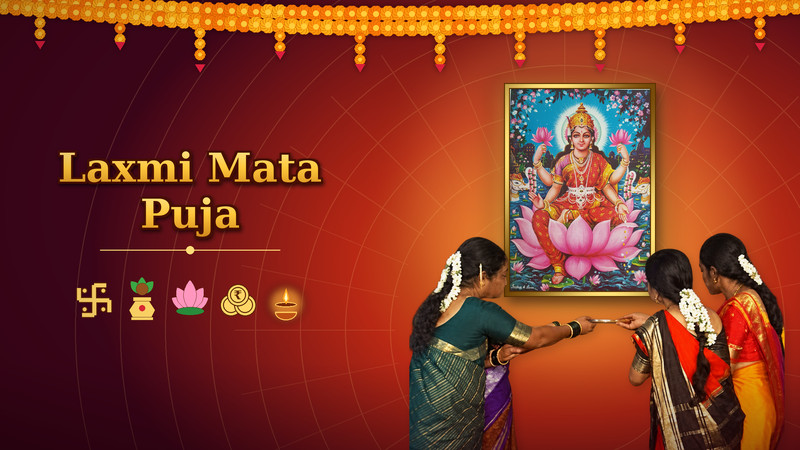
Lakshmi Puja is a festival and ritual in Hinduism for Goddess Lakshmi. Lakshmi Mata is the goddess of wealth, good luck, and abundance. This puja is mostly performed on the night of the new moon day (Amavasya) of Diwali. Hindu families pray for prosperity and wealth and invite Goddess Lakshmi into their homes.
When is Lakshmi Puja in 2026?
Best Time to Perform Lakshmi Puja
On Diwali, Lakshmi Puja should be performed during Pradosh Kaal. This period begins after sunset and lasts approximately two hours and twenty-four minutes. Performing Lakshmi Puja takes around 15 to 45 minutes. Pradosh Kaal is considered the best auspicious time for Lakshmi Puja. It is believed that if the puja is performed during a fixed ascendant (Sthir Lagna), Goddess Lakshmi stays in your home permanently. Therefore, Pradosh Kaal is considered the most auspicious time for Lakshmi Puja.
You should select your city before checking the auspicious timings for Lakshmi Puja and perform it according to your local timings.
Main Muhurat Timings for Major Cities (November 8, 2026)
| City | State / Union Territory | Lakshmi Puja Muhurat |
|---|---|---|
| New Delhi | Delhi | 5:54 PM–7:50 PM |
| Mumbai | Maharashtra | 6:27 PM–8:27 PM |
| Pune | Maharashtra | 6:24 PM–8:24 PM |
| Kolkata | West Bengal | 5:20 PM–7:18 PM |
| Chennai | Tamil Nadu | 6:07 PM–8:09 PM |
| Bengaluru | Karnataka | 6:17 PM–8:20 PM |
| Hyderabad | Telangana | 6:07 PM–8:08 PM |
| Ahmedabad | Gujarat | 6:22 PM–8:20 PM |
| Jaipur | Rajasthan | 6:03 PM–7:59 PM |
| Gurugram | Haryana | 5:55 PM–7:51 PM |
| Noida | Uttar Pradesh | 5:54 PM–7:49 PM |
| Chandigarh | Chandigarh | 5:52 PM–7:46 PM |
Pradosh Kaal in New Delhi: Roughly 05:31 PM to 08:09 PM (varies slightly according to local sunset)
Kartik Amavasya Tithi Begins: November 8, 2026, at 11:27 AM
Kartik Amavasya Tithi Ends: November 9, 2026, at 12:31 PM
Vrishabha Kaal (Fixed Lagna): An ideal period for worship seeking stability and wealth, occurring shortly after sunset during Pradosh Kaal.
Preparations for Lakshmi Puja
Preparations for Lakshmi Puja and Diwali begin several days in advance. People thoroughly clean their homes. Hindu families decorate their homes and offices with marigold flowers and Ashoka, mango, or banana leaves. Placing a “Mangalik kalash” topped with an unhusked coconut on either side of the main entrance is considered auspicious.
Preparation for Lakshmi Puja depends on family customs. A rug or red or yellow cloth is spread on a raised platform. Place the idols or pictures of Goddess Lakshmi, Lord Ganesha, and Goddess Saraswati on it. You can also place a picture frame in which all three deities are present. The idols are decorated with silk garments and ornaments. You will also require a plate; place a kalash upon it and fill the kalash three-quarters full with water. You can drop a coin, betel nut, grain, and a pinch of turmeric. You can also arrange five green mango leaves around the kalash and put a coconut on top. Apply kumkum, haldi (turmeric), and sandalwood (chandan) paste to the idols, the kalash, and your account books or wallet. The list of items required for Lakshmi Puja includes a diya, akshat (rice), kumkum, fresh flowers, fruits, and prasad.
How to perform Lakshmi Puja?
Now light a lamp (diya), remove negative thoughts from your mind, state the intention of worship, and offer flowers and food to Lakshmi and other deities. In some traditions, nine piles of unbroken rice are arranged on a white cloth to establish the Navagraha, and sixteen piles of wheat or wheat flour are arranged on a red cloth. A Lakshmi Puja process starts with invoking Ganesha, chanting the Lakshmi mantra (Om Shreem Mahalakshmyai Namah), and performing aarti. When the uja is complete, distribute the prasad among the family members. Lakshmi Puja can be performed in different ways. Some people follow the family-prescribed rituals or individual customs and traditions.
Lakshmi Puja Fasting
Fasting is not mandatory for Lakshmi Puja. Some devotees observe a day-long fast and break it after the evening puja. While observing a fast for Lakshmi Puja or Vaibhav Lakshmi Vrat, you may eat light and sattvic (pure) foods, such as fresh fruits, milk, yogurt, dried fruits, nuts, and specific grains or flours permitted during fasting.
What is the story behind Lakshmi Puja?
The story behind Lakshmi Puja is based on two main traditional Hindu stories: the churning of the ocean and Lord Rama’s return to Ayodhya.
Churning of the Ocean
In the Satya Yuga, the gods and demons churned the Kshira Sagara (Ocean of Milk) using the serpent Vasuki to recover lost treasures and the nectar of immortality. On the new moon night of the month of Kartik, Goddess Lakshmi emerged from the Ocean of Milk, seated on a lotus flower, and chose Lord Vishnu as her husband.
Lord Rama's Return
According to another major tradition, the day of Lakshmi Puja is associated with the return of Lord Rama, Sita, and Lakshmana to Ayodhya. Their return followed 14 years of exile and the defeat of the demon king Ravana.
Goddess Lakshmi arrives
It is believed that on this Amavasya night, Goddess Lakshmi travels across the earth and visits clean, brightly lit homes where doors and windows are open, and lamps are lit to welcome her.
Why are Lakshmi, Ganesha, and Saraswati worshiped together?
Worshiping Goddess Lakshmi, Saraswati, and Lord Ganesha together balances wealth and wisdom. Wealth cannot be properly utilized without wisdom and the right knowledge. Without wisdom (Ganesha) and knowledge (Saraswati), wealth (Lakshmi) is hard to keep or use well. Some traditions explicitly include Lord Vishnu in the worship, and Lord Kubera may also be worshiped alongside her.
What is Kojagari Lakshmi Puja?
Kojagari Lakshmi Puja is a traditional Hindu festival in honor of Goddess Lakshmi. It is celebrated on the full moon night of Sharad Purnima with prayers for wealth, prosperity, and well-being. Kojagari Lakshmi Puja in the year 2026 will be observed on Sunday, the 25th of October, which falls on the day of Sharad Purnima. Kojagari Lakshmi Puja is celebrated in the autumn season on the full moon day of the month of Ashwin, whereas Diwali Lakshmi Puja is celebrated on the new moon night of the month of Kartik. This festival is celebrated around five days after Vijayadashami to welcome Goddess Lakshmi.
Benefits of Performing Lakshmi Puja
Devotees believe that performing Lakshmi Puja invites Lakshmi's blessings for spiritual, mental, and personal benefits. During Deepawali, it often honors Lord Ganesha, Goddess Lakshmi, and Goddess Saraswati together to invite overall prosperity, intellect, and spiritual growth. The worship is also associated with gratitude and inner peace.