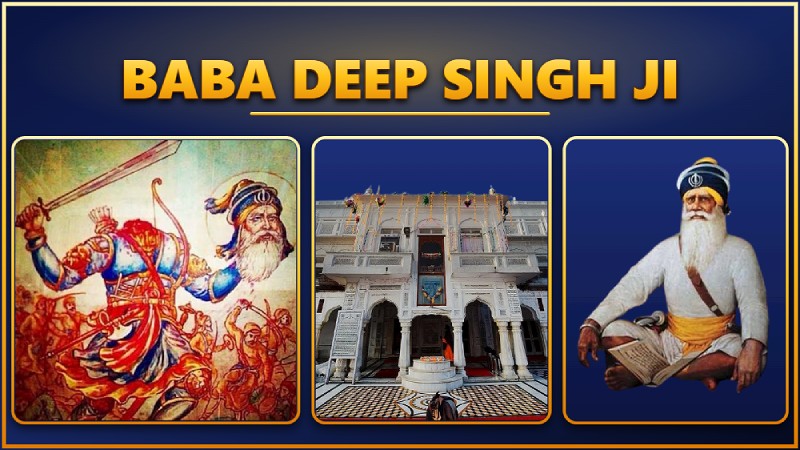
Baba Deep Singh Ji was born into the Sandhu Jatt family. Baba Deep Singh was born on 26 January 1682 (14 Magh 1739 Bikrami), in Pahuwind village, Patti tehsil, which was then in Lahore district and is now in Tarn Taran. His childhood name was Deepa.
When is Baba Deep Singh Ji Janam Dihara and Shaheedi Diwas in 2026?
Baba Deep Singh Ji Shaheedi Diwas is on Sunday, 15 November 2026 and Janam Dihara (birthday anniversary) is on Wednesday, 27 January 2027, according to the SGPC calendar. Sikhs observe both occasions at Gurdwaras every year.
| Event | Date |
|---|---|
| Martyrdom Day of Baba Deep Singh Ji | 15 November 2026 |
| Birth Anniversary of Baba Deep Singh Ji | 27 January 2027 |
About Baba Deep Singh
Baba Deep Singh Ji is one of the most respected martyrs in Sikh history. He is remembered as a saint and soldier for his deep devotion to the Sikh Gurus, his knowledge of Sikh teachings, and his sacrifice while defending Sri Harmandir Sahib. Baba Deep Singh served in several Panthic battles, played an important part in preparing the Damdami Bir, and attained martyrdom at Amritsar while leading the Shaheedan Misl. He led the Shaheedan Misl, one of the twelve Misls. He played a leading role in writing copies of the Guru Granth Sahib and in the major battles of the eighteenth century.
Who were Baba Deep Singh Ji’s parents?
The father of Baba Deep Singh was Bhai Bhagtu Ji, who was also known as Bhai Bhagata Ji. His mother was Mata Jeoni Ji, and she was also known as Mai Jioni. They had no children for a long time. A saint blessed them with a son named “Deep” and later a second son, Bhai Lala.
When did Baba Deep Singh Ji meet Guru Gobind Singh Ji?
When Baba Deep Singh Ji went to Anandpur Sahib with his parents, he met Guru Gobind Singh Ji for the first time at the age of twelve. When Baba Deep Singh Ji’s parents were about to return home, Guru Gobind Singh Ji asked Baba Deep Singh Ji to stay with him, after which Baba Deep Singh Ji stayed with Guru Gobind Singh Ji and served there. During this time, Baba Deep Singh Ji learned Gurmukhi, scriptural interpretation, horse riding, and weaponry from Guru Ji and Bhai Mani Singh Ji. He learned Arabic, Persian, and the Braj languages.
When did Baba Deep Singh Ji take Amrit?
According to some Sikh sources, Baba Deep Singh Ji received Amrit on Vaisakhi day in 1700 at the age of eighteen.
What was Baba Deep Singh Ji’s connection with Damdama Sahib and Damdami Taksal?
When the Damdami Bir was being written at Damdama Sahib, Baba Deep Singh served by providing kalam (pens) and ink. Guru Gobind Singh Ji appointed him as the head of Takht Sri Damdama Sahib in 1706. He wrote four copies of Sri Guru Granth Sahib during his stay at Damdama Sahib. When Guru Ji departed for the south, he gave Baba Deep Singh five duties: teaching students, spreading Gurbani and Sikh history, administering Amrit and strengthening the Rehat, and supporting the Panth during difficult times. He is called the first head of the Damdami Taksal. He also handwrote small hymn collections (gutkas) to distribute to the Sangat.
Battles Baba Deep Singh Ji Fought Alongside Banda Singh Bahadur
In 1708, when Guru Gobind Singh Ji sent Banda Singh Bahadur to Punjab with Hukamnamas asking the Sikhs to help him, Baba Deep Singh led a group of 500 Singhs. He also took part in the battles of Sirhind, Samana, Sadhaura, Chhat Banur, and Saharanpur. After Sirhind, Banda Singh gave him the title of “Living Martyr.” After Banda Singh Bahadur’s martyrdom, Baba Deep Singh was the first Jathedar of the Shaheedan Misl. When the eleven Misls were formed, he took charge of a Misl that was later called the Shaheedan Misl. In 1733, he joined the Sarbat Khalsa, and then he was made the head of a Jatha of the Budha Dal. Baba Deep Singh Ji commanded one of the five jathas of the Taruna Dal. During the reorganisation of the Dal Khalsa in 1748, his group became one of the twelve misls and later became known as the Shaheedan Misl.
He led missions to ambush Ahmad Shah Abdali’s forces during their raids, freeing captive Indian men and women.
Baba Deep Singh Ji’s Final Battle and Martyrdom
After looting Delhi, Abdali left in April 1757. But Abdali's general Jahan Khan’s forces demolished the Sikh fort of Ram Rauni, then filled the Amritsar Sarovar with filth, desecrated Sri Harmandir Sahib, and demolished the Harmandir fort. At Tarn Taran, Baba Deep Singh prayed ahead of Guru Arjan Dev Ji: "I will not rest until I remove the tyrants’ flags from Amritsar. I have set out to attain martyrdom, and I will attain martyrdom only at the feet of Guru Ram Das Ji.”
Sikh sources say Jahan Khan had taken up a position at Gohalwar with 10,000 soldiers and 30,000 local Muslims who supported the government. The number of Singhs accompanying Baba Deep Singh Ji had increased to 5000 by the time he reached Tarn Taran.
On 11 November 1757, Baba Deep Singh Ji advanced from Tarn Taran with the Singhs, and a fierce battle took place with Jahan Khan’s army near Gohalwar. Baba Ji formed three large groups of Singhs. Baba Gurbaksh Singh Ji was on the right, Baba Naudh Singh Ji was in the centre, and Baba Deep Singh Ji himself was fighting on the left, where the enemy was strongest. He held an 18-seer Khanda in his hand.
According to this account, in the face-to-face fight with Jamal Khan, both their heads were severed. A Singh standing nearby reminded Baba Ji of his vow, saying that he was to offer his head at the feet of Guru Ram Das Ji and that Sudhasar was still three miles away. A voice came from the severed head, saying, “The Singh’s vow will be fulfilled to the end.”
According to Sikh tradition, Baba Deep Singh Ji continued fighting while holding his severed head on his left palm and wielding his Khanda with his right hand, fulfilling his vow to reach Sri Harmandir Sahib. Baba Ji passed beyond Ramsar, reached the Parikrama of Sri Harmandir Sahib’s Sarovar, and offered his head.
Cremation and Memorial Gurdwaras
Some Gurdwaras have been built in memory of Baba Deep Singh Ji.
- Gurdwara Shaheedganj Baba Deep Singh Ji Shaheed is the place where he was cremated.
- Gurdwara Shaheed Bunga is the place where his head was placed within the precincts of Sri Harmandir Sahib. A Nishan Sahib was erected where his body fell, and the Guru Granth Sahib was installed there.
- Gurdwara Tahla Sahib marks the place where his head was severed.
- The Damdami Bir was written at Gurdwara Likhansar (Damdama Sahib).
Baba Deep Singh Ji wielded an 18-seer khanda at the age of 75 and fought to avenge the desecration of Sri Darbar Sahib, Amritsar. In this battle, he attained such martyrdom and fulfilled his vow. Baba Deep Singh is recognised as an important figure in Sikh history who attained martyrdom on 11 November 1757 while fighting against the ruling power.