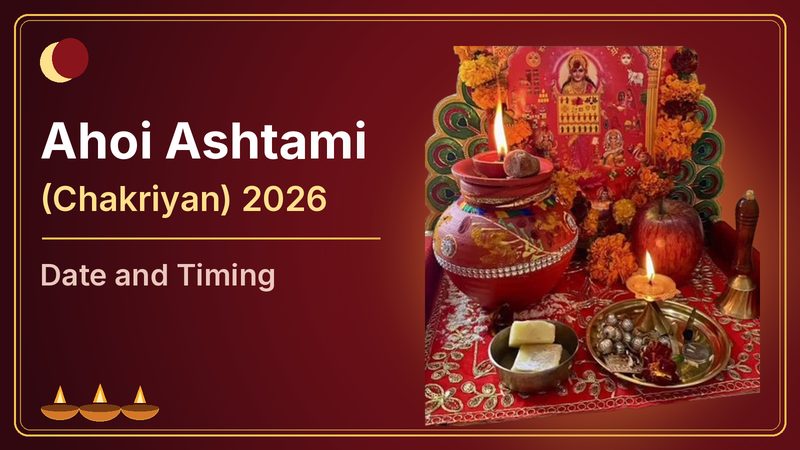
Ahoi Ashtami is a traditional Hindu festival observed mainly by mothers for the long life, health, and well-being of their children. It is also known as Ahoi Aathe, Chakriya, or Chakri Vrat in Punjabi-speaking regions and among North Indian families. It is especially popular in North India. The day is called Ahoi Aathe because Ashtami is the eighth day of the lunar fortnight, and the fast is observed on that tithi. It comes four days after Karwa Chauth and eight days before Diwali.
When are Chakriya and Ahoi Ashtami in 2026?
Ahoi Ashtami puja, star sighting, and moonrise timings
| City | Evening Puja Muhurat | Star Sighting (Sanjh) | Moonrise |
|---|---|---|---|
| Delhi | 05:36 PM to 06:54 PM | Around 06:00 PM | 11:40 PM |
| Chandigarh | 05:35 PM onwards (from sunset) | Around 06:00 PM | 11:38 PM |
| Amritsar | 05:41 PM to 07:00 PM | Around 06:07 PM | 11:44 PM |
| Mumbai | 06:04 PM to 07:20 PM | Around 06:27 PM | 12:15 AM |
Timings are in Indian Standard Time (IST). Puja muhurat, star-sighting time, and moonrise vary by location, so please confirm the timings for your city.
Chakriya and Ahoi Ashtami fasting
On the day of Chakriya, mothers fast and perform puja for the well-being and long life of their children. The fast is dedicated to Ahoi Mata. Women wake up early in the morning and, after bathing, take a pledge, also called sankalp, to observe the fast for their children’s well-being. During this sankalp, mothers also decide that the Chakri Vrat will be observed without eating or drinking anything the whole day. Most families break the fast after the evening puja, once they have seen the stars and offered arghya, while others wait for moonrise.
Ahoi Ashtami fasting rules and customs
Ahoi Ashtami vrat is traditionally observed as a nirjala fast, with no food or water from sunrise until the evening rituals. This includes avoiding fruit, milk, grains, and salt during fasting hours. Some families follow a modified fast with fruit and water. Pregnant or unwell women should seek medical advice before fasting. Not all families follow sargi on Ahoi Ashtami, though some do observe a pre-dawn meal.
Chakriya and Ahoi Ashtami evening puja
Puja preparations are finished before sunset. Women either draw the image of Goddess Ahoi on the wall using geru or embroider it on a piece of cloth and hang it on a wall. Any image of Ahoi Mata used for the puja should have Ashta Koshthak, i.e., eight corners, since the festival is associated with Ashtami Tithi. Along with Goddess Ahoi, the image includes young children and a lion. On the first Ahoi Ashtami, especially when observed after a son’s wedding or the birth of a first child, the daughter-in-law presents a special bayna plate to her mother-in-law.
The place of worship is then sanctified with holy water, and an alpana is drawn. After one water-filled kalash (pot) is kept at the place of worship on a wooden stool. The mouth of the kalash is covered with an earthen lid.
A small earthen pot, preferably a karwa, is kept on top of the kalash. The karwa is filled with water and covered with its lid. The nozzle of the karwa is blocked with shoots of grass. The commonly used shoot is known as Sarai Seenka, which is a type of willow. Seven shoots of grass are also offered to Ahoi Mata and the lion. Sarai Seenka is sold during the festival, especially in the small towns of India. If grass shoots are not available, cotton buds can be used.
The Chakri is also filled with homemade foods like gulgule, khoa barfi, puris, batasha, and rice murmura, along with other snacks and sweets that children like. After the puja and prayers are complete, this Chakri is given by the mother to her sons or daughters.
The food items used in the puja include 8 puris, 8 puas, and halwa. These are given to a Brahmin along with some money. However, this is not a universal rule, so you can perform the Chakriya puja according to your own tradition.
How to offer water to the stars on Ahoi Ashtami?
After completing the evening puja, katha, and aarti, mothers wait for the first stars to appear. They take clean water in a karwa or lota and gently pour it onto the ground while facing the stars, praying for their son’s or daughter’s health, safety, and long life. They then seek blessings from elders and break their fast with water and prasad. Some families wait for moonrise instead, following their household customs.
Mothers and other family or neighborhood women gather for this ritual. They take part in the star arghya on the roof or anywhere else where the stars are clearly visible. They all hold the karwa with one hand and sing a traditional song for their children’s well-being. After completing the arghya steps, they offer the karwa water to the stars. They also bring sweets like barfi, jaggery, or other sweet foods and distribute them among themselves after the arghya.
The story behind it
A traditional story associated with this festival is widely known.
Long ago, a moneylender’s wife lived with her seven sons. As Diwali approached, she went to the forest to collect soil for repairing her home. While digging, her spade accidentally struck a baby animal called a “syahu” (often described in this story as a porcupine or a spiny animal), causing its death.
The woman had not intended to harm any living creature. But the mother of the beast cursed her, saying she would also know the pain of losing her children. All seven of the woman’s sons died within a year.
The woman, overcome by grief, remembered the accident in the forest and wondered if her family’s suffering was related to that event. She told this to the old women of her village and apologized for what had happened. She asked them how she could get forgiveness.
A wise woman told her to worship Ahoi Mata, who is believed to be a form of Goddess Parvati or Bhagwati. She also requested her to paint a picture of Goddess Ahoi with the syahu and her young ones on Kartik Krishna Ashtami and pray with a pure heart. She drew holy pictures; she fasted and prayed to be forgiven for the life she had accidentally taken. Her prayers were for sorrow for her own children, and for the syahu and her young.
According to the story, Ahoi Mata was pleased with her sincere repentance and blessed her, and consequently all her seven sons came back to life. The mother who had once been overcome by grief now had joy return to her home.
This traditional story connects the Ahoi Ashtami fast with a mother’s love, compassion for living creatures, and the hope of forgiveness. Although its details may differ across regions and families. Its main message remains centered on sincere devotion and care for children.
Which states celebrate Ahoi Ashtami?
Ahoi Ashtami is celebrated mainly in North India. The festival is celebrated in Haryana, Punjab, Uttar Pradesh, and Delhi. It is also observed in Gujarat and Maharashtra, according to their respective lunar calendars.
Traditional foods and sweets prepared for Ahoi Ashtami
Families prepare traditional sweets and vegetarian dishes for Ahoi Ashtami. These foods are offered to Ahoi Mata as bhog and shared as prasad. There is no single menu followed by every household, and families often prepare the foods customary in their own homes.
- Gulgule, also called atte ke pua, are sweet, deep-fried fritters made from wheat flour and jaggery or sugar.
- Sooji halwa or atta halwa is another festive preparation.
- Kheer adds a creamy sweet dish to the offerings.
- Puri and aloo sabzi are a familiar combination.
- Malpua, sweet pancakes dipped in sugar syrup, are also made by some households.
Some people celebrate this festival as Chakriya or Chakri Vrat, and others celebrate it as Ahoi Ashtami, but in both cases people worship and pray to Ahoi Mata.