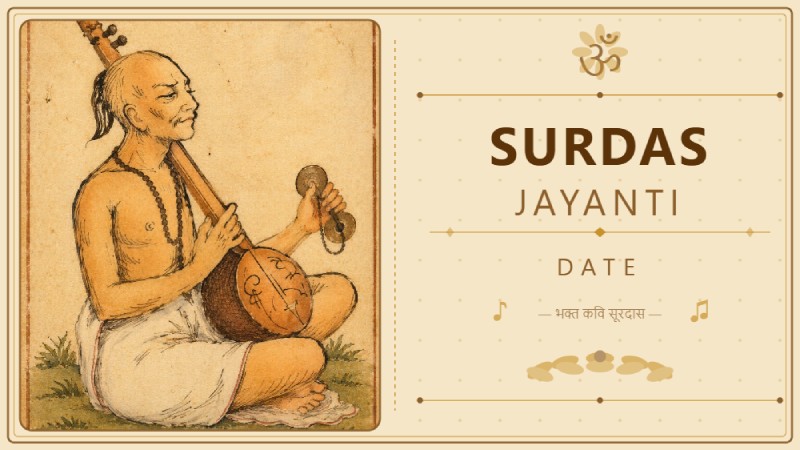
Surdas Jayanti is the birthday of the saint and poet Surdas. He is known as a holy soul and a true devotee of Lord Krishna. The word Surdas means "servant of melody" or "servant of the sun". Surdas Jayanti is a Hindu celebration observed in the Northern part of India. He was a 16th-century Hindu religious poet and singer who was known for his poems and religious songs praising Lord Krishna. Surdas is also called Bhakt Kavi Surdas.
So, when is Surdas Jayanti in 2026? Surdas Jayanti is observed on Tuesday, April 21, 2026. It is the 548th Birth Anniversary of Sant Surdas. The birthday of Saint Surdas is observed on the 5th day (Panchami Tithi) of the Shukla Paksha during the month of Vaishakh.
When is Surdas Jayanti in 2026?
According to historians, Sant Surdas was born in 1478 C.E. in the village of Sihi, Faridabad, Haryana. However, some believe he was born in Runkta near Agra. It is also believed that he was born in the 15th century in Braj, a place connected to the early life of Lord Krishna. The exact date of Surdas's birth is unclear and has been put as early as 1478 or 1479 AD. Surdas Jayanti is observed in 2026 on Tuesday, April 21, 2026, when panchami begins at 04:14 AM on Apr 21, 2026, and ends at 01:19 AM on Apr 22, 2026.
Significance of Surdas Jayanti
Surdas Jayanti is a celebration day of the life, teachings, and work of the saint-poet Surdas. He was blind from birth, and because of that, his family ignored him. So, he left home at the young age of six and started praising Lord Krishna from a very early age. He began living near the river Yamuna. His jayanti gives devotees a chance to think about his great spiritual and literary gifts. The festival is especially loved in places like Braj, where Krishna's divine childhood is deeply valued.
Surdas's teachings highlighted the power of a personal bond with God. He teaches us the power of focused devotion and being happy with what one has. He wrote bhajans that carried good moral and spiritual lessons using short scenes from Krishna's life. Surdas's poetry is not just a show of devotion, but it is also a clear picture of social and daily life. Through the everyday language of common people, Surdas helped the common man feel close to God.
Life and Works of Sant Surdas
He was well known for his writing skills, bhajans, poems, and couplets. He expressed his devotion through Vatsalya Ras and was a sincere follower of Lord Krishna. Surdas became so well known that even the Mughal Emperor Akbar became his supporter. He was also a well-known thinker, artist, and musician of India who was visually impaired. He wrote bhajans in simple Braj language, as before that, the main languages used were Persian or Sanskrit. Some bhajans are also written in other languages of medieval Hindi, like Awadhi. His works helped in spreading the Bhakti movement across North India.
Surdas has a big contribution to Bhakti literature for Hinduism. Surdas is believed to have written about thousands of songs in his greatest work, the Sur Sagar (Sea of Melody), out of which only around 8,000 are still available today. His other key works include Sursaravali and Sahitya Lahari.
It is widely believed that Surdas was blind from birth. However, some historians, like Dr. Krishnadutt Bajpai, suggest his blindness may have come later in his early years of life. Though Surdas could not see with his eyes, Lord Krishna gave him a divine inner sight because of his deep devotion. Surdas Ji's guru was Shri Vallabhacharya.
How is Surdas Jayanti Celebrated?
Devotees across India take part in the celebrations to honour this great saint-poet of the Bhakti tradition. Surdas Jayanti is observed in many meaningful and spiritual ways. One of the most common practices is gathering in temples or homes to sing his devotional hymns that praise the divine love of Krishna. Devotees also pray and meditate, focusing on Surdas's teachings of simple love and deep devotion to God. Some people fast, while others take part in community meals as an act of sharing and thankfulness. In places closely tied to Lord Krishna, like Braj, special walks, kirtans, and group gatherings are held to celebrate his birth.
Surdas Jayanti holds a unique double celebration. It is both a religious event and a celebration of literary and musical heritage. This is because Surdas was not only a saint and devotee, but also a great poet and musician. Bhajan and kirtan are at the heart of Surdas Jayanti celebrations. Special programs are organised in Vrindavan, where Surdas spent most of his life. The Hare Krishna mantra is often chanted during Surdas Jayanti because it matches Surdas's deep devotion to Lord Krishna: Hare Krishna, Hare Krishna, Krishna Krishna, Hare Hare.
Some Famous Dohas or Songs by Surdas are 'Maiya Mori Main Nahin Makhan Khayo', 'Maiya Kabahin Badhegi Choti', 'Ankhiyan Hari Darshan Ki Pyasi', 'Mero Man Anat Kahan Sukh Pavai', and many more.
Early Life and Childhood of Sant Surdas
Surdas' childhood was filled with great hardship. Because of his blindness, he faced rejection and disrespect in society. Still, from his very early years, he stayed deep in the devotion of Lord Krishna. His family was very poor and had neither money nor social standing. To stand on his own feet, Surdas left home at a young age and started a new life near Gau Ghat. When Lord Krishna offered to give back his sight, Surdas said no: "I wish to see no one other than You; so please make me blind again."
Legacy of Sant Surdas
Some people believe that Surdas is the Adi Guru of Hindi writing. His literary legacy inspired great Bhakti poets like Tulsidas, Mirabai, Rahim, and Raskhan. He is important for Indian culture as a 16th-century blind poet-saint who revolutionized Hindi literature and showed his deep and true devotion (Bhakti) to Lord Krishna.
People remember Surdas on his Jayanti because he was not just a poet or saint but also his entire life was spent in devotion to Krishna. It is a day to reflect on the depth of Surdas's teachings and the powerful change they brought to the spiritual lives of many devotees. The message of Surdas's jayanti and writings is the path of unconditional love, absolute surrender, and Bhakti to Lord Krishna. He is still remembered for his religious music dedicated to Lord Krishna.