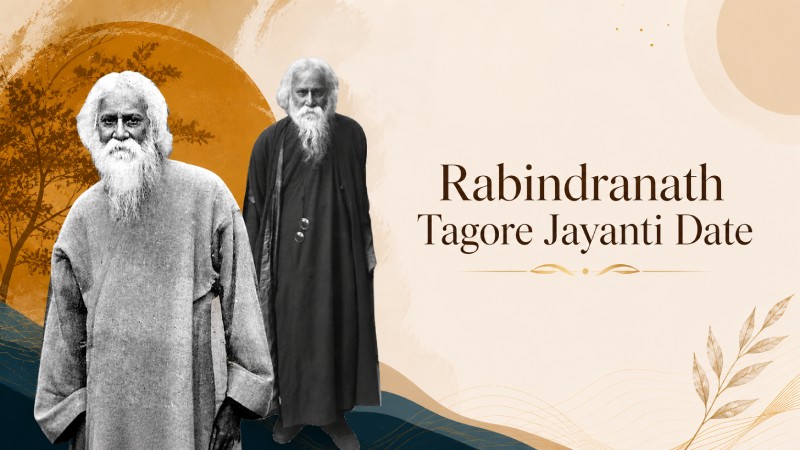
Rabindranath Tagore Jayanti or Rabindra Jayanti is the birth anniversary day of Rabindranath Tagore. He was one of India's greatest poets, writers, philosophers, painters, music composers, and educators. It is celebrated to honor his outstanding contributions to literature, music, education, art, and Indian culture.
When is Rabindranath Tagore Jayanti in 2026?
In 2026, Rabindranath Tagore Jayanti is celebrated on the 7th of May all over India and in the Indian state of West Bengal. Bangladesh is observed on the 25th day of the Bengali month of Boishakh (Baisakh), usually falling in early May each year, around the 7th or 8th. It is the 165th birth anniversary of Nobel laureate Rabindranath Tagore. He was born on May 7, 1861, in Calcutta (now Kolkata), India. His parents' names were Debendranath Tagore and Sarada Devi.
About Rabindranath Tagore
Rabindranath Tagore revolutionized Indian literature, especially Bengali literature, through poetry, short stories, novels, essays, plays, and songs that inspired millions. He was only 13 when he wrote his first poem. He is respectfully called "Gurudev" because of his wisdom, spiritual depth, and immense influence as a teacher and thinker. Rabindranath Tagore wrote the famous Indian national anthem song "Jana Gana Mana" and the Bangladesh national anthem song "Amar Sonar Bangla." This made Tagore's contribution to the nation historic and unforgettable.
The major themes in Tagore's poetry are God and the human soul, God and Nature, Nature and the soul, and the soul and humanity. His poetry primarily explored love, nature, spirituality, freedom, humanity, and peace.
One of his first major literary works was Bhanusimha Thakurer Padavali around 1877 and Sandhya Sangit (1882), which established him as a promising poet.
Through his writings, he promoted values like humanism, creativity, unity, freedom, compassion, and respect for nature. Rabindranath Tagore's ideology was based on humanism, internationalism, and spiritual nationalism. He believes that humanity is more important than narrow national borders.
Tagore Jayanti and Bengali Culture
Tagore Jayanti is strongly connected to Bengali culture because his poetry, songs, and ideas remain an important part of Bengal's identity.
How is Rabindranath Tagore Jayanti Celebrated?
Rabindranath Tagore Jayanti (Pochishe Boishakh) is celebrated the day through speech competitions, poetry recitations, singing programs, and cultural performances based on Tagore's works. Activities often include sketching Tagore's portrait, dressing as him, drama performances like Dak Ghar, and educational presentations on his life. Cultural celebrations often include Rabindra Sangeet, dance performances, dance drama, poetry recitation, and discussions about his life and achievements. Rabindra Sangeet, the songs written and composed by Tagore, plays a central role in celebrating his birth anniversary. It is the emotional and cultural heartbeat of Tagore Jayanti celebrations.
Rabindranath Tagore Nobel Prize
Rabindranath Tagore won the Nobel Prize in Literature in 1913. He received the Nobel Prize for his famous work, Gitanjali. Tagore was the first Asian to win a Nobel Prize.
Tagore's Contribution to Education and Nationalism
He influenced Indian education by promoting creative learning, education close to nature, and freedom of thought.
He contributed to Indian nationalism through his writings, composing national anthems, and by returning his knighthood after the Jallianwala Bagh massacre in protest.
Famous Works of Rabindranath Tagore
His famous short stories include Kabuliwala and The Postmaster, both admired for their emotional depth and human values. His most famous short stories also include Subha, The Hungry Stones, and The Broken Nest (Nastanirh).
Tagore's Philosophy on Nature
He believed nature was deeply connected to human life and saw it as a source of beauty, wisdom, peace, and spiritual inspiration. Rabindranath Tagore is remembered today as a world-famous poet, Nobel laureate, philosopher, educator, and cultural icon whose legacy continues to inspire generations. He died at the age of 80 on August 7, 1941. The Government of India issued a 5 rupee coin to mark the 150th anniversary of Rabindranath Tagore's birth in 2011.