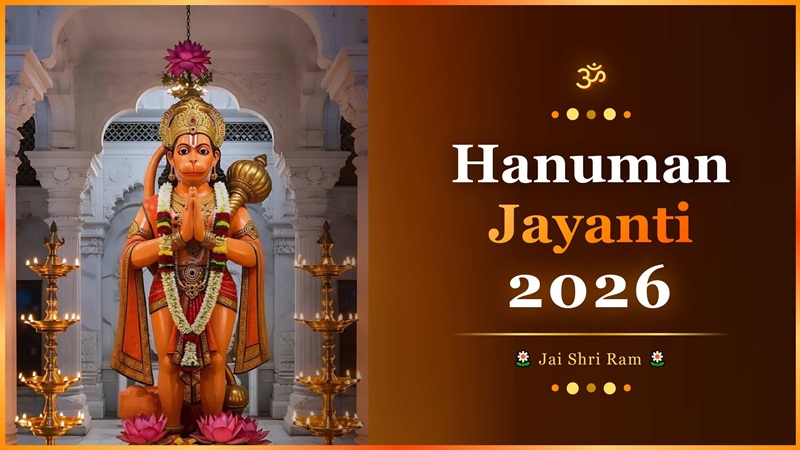
Hanuman Jayanti is another Hindu festival that is celebrated as the birth of the Hindu deity Hanuman every year. It is also called Hanuman Janmotsav. Hanuman ji is a main character in the Ramayana because he is widely considered the greatest devotee of Lord Rama. He is known for his unwavering devotion, courage, wisdom, and strength. He is loved as Sankat Mochan and protects people from negative energy.
About Lord Hanuman
Hanuman is a vanara (monkey deity). Hanuman Ji's mother's name is Anjana, and his father's name is Kesari. He is also known as Pavanputra (the son of Vayu), Bajrangbali, Anjaneya, and Mahaveer. Hanuman has the power to defeat evil and give protection.
When is Hanuman Jayanti 2026?
Hanuman Jayanti is celebrated during the month of Chaitra in the Hindu calendar, which falls in the months of March and April. This year, Hanuman Jayanti will be celebrated on Thursday, April 2, 2026. It falls on the Purnima (full moon) day of the Chaitra month in North India and Margashirsha Amavasya in South India. The Tithi begins at 7:06 AM on April 1, 2026, and ends at 7:41 AM on April 2, 2026. The date and time of Hanuman Janmotsav vary in each state of India.
Significance of Hanuman Jayanti
This festival represents faith, humility, and self-control for a higher purpose. The devotees celebrate his birth on Hanuman Jayanti. They pray for their protection, fearlessness, courage, and blessings.
Hanuman Jayanti Celebrations
People gather in temples to worship him. Hanuman idols are decorated with sindoor mixed with jasmine oil, sandalwood paste, and red or yellow flowers, especially marigolds. They visit temples and apply vermillion on their foreheads from Hanuman's idol. After prayers and offering gifts, they receive prasadam in return. Many Hindu people read the Hanuman Chalisa, the Ramayana, the Bajrang Baan, and the Sundara Kanda. Some people also perform a Hanuman puja at home.
Offerings and Rituals
People also offer sweets and fruits like laddoos, boondi, and imarti to Hanuman, bananas, chana, jaggery, and coconut. Red flowers or tulsi garlands are used in Pooja. Many devotees keep a fast (vrat) on Hanuman Janmotsav. Hanuman is worshipped particularly on Tuesdays and Saturdays. Many devotees observe a fast on these days. There are countless idols and temples dedicated to him across India, such as Khajuraho's oldest standalone Hanuman temple, Hanuman Garhi temple in Ayodhya, and Jakhu Temple in Shimla.
Hanuman's Role in the Ramayana
Hanuman ji has an important role in the Hindu Ramayana. He is a Brahmachari, a great scholar, and a master of the Vedas. A few incidents, which are listed in Ramayana, during the search for Sita, Ram and Lakshman reached Kishkindha, where Sugriva helped them and sent Hanuman to the south, and he found Sita in Ashok Vatika in Lanka. After meeting Sita, Hanuman destroyed Ashok Vatika. He was also captured, and when his tail was set on fire, he burned a large part of Lanka, which is known as the burning of Lanka. During the war, when Lakshman was unconscious, Hanuman went to the Himalayas for the Sanjeevani herb. When he was unable to identify it, he carried the whole mountain to save his life.
Legacy of Hanuman
After the war, Hanuman refused any reward. He showed Ram and Sita in his heart by tearing his chest. He asked only for devotion to receive the blessing of immortality. Hanuman is a symbol of the supreme synthesis of strength and devotion. Hanuman is still as alive and relevant today as he was thousands of years ago because he is immortal, and his story will continue forever.