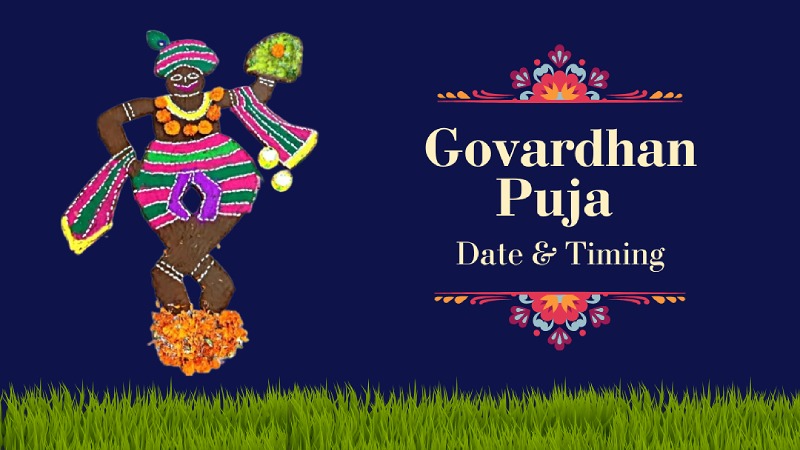
Govardhan Puja is a Hindu festival. It is celebrated as part of the five-day Diwali festival. It commemorates the divine leela of Shri Krishna. According to belief, Shri Krishna lifted Govardhan Hill to protect the people of Vrindavan from the wrath of Indra Dev. This festival is also known as Annakut. It is traditionally believed that worshipping Govardhan and offering Annakut brings food grains, happiness, and prosperity to the home.
When is Govardhan Puja in 2026?
Govardhan Puja is usually the day after Diwali, but sometimes there is a day in between. This is because the date of the festival is based on the Hindu lunar tithi and not solely on the Gregorian calendar date.
Govardhan Puja Muhurat Time 2026
Govardhan Puja Pratahkala Muhurat New Delhi - November 10, 2026 - 6:40 AM to 8:50 AM
The exact puja muhurat varies according to the location, as the sunrise time differs from city to city. So check your local panchang for the auspicious time.
How to perform Govardhan Puja at home?
Devotees should wake up early. They can take a bath before beginning the puja. Then clean the worship area, light diyas and incense sticks. A small mound representing Govardhan Hill is prepared using cow dung. Where cow dung is not available, some families use buffalo dung, cooked rice, clay, a brass or clay image, or a picture representing Govardhan. The Govardhan mound can be decorated with flowers, rangoli, akshat, kumkum, grass, and small figures of cows, cowherds, peacocks, and Shri Krishna.
A Krishna or Laddu Gopal image is placed near the Govardhan mound. A kalash containing water, mango leaves, and a coconut may also be placed near the deity. A short prayer to Ganesha is performed first. Water, roli, akshat, flowers, incense, and a lamp are then offered to Govardhan and Krishna.
Annakut is prepared and offered. Devotees chant Krishna mantras and devotional songs. Parikrama is performed around the Govardhan mound. Many households perform it seven times.
Cows and bulls may be bathed, decorated with flowers, and worshipped. They are fed green fodder, jaggery, and prasad. The puja is concluded with Govardhan Aarti, after which the prasad is distributed. However, the Govardhan puja process may vary by location and local rituals.
What is the Govardhan Puja samagri list?
There are many items required, such as fresh cow dung, cooked rice, clay, or a Govardhan image that can be used for the Govardhan hill.
Other puja items include:
- Flowers, akshat, kumkum, roli, chandan, grass, and twigs.
- A chowki for placing a Krishna, Radha-Krishna, or Laddu Gopal picture.
- A kalash, water, mango leaves, and coconut.
- A pooja thali, bell, lota, camphor, agarbatti, and dhoop.
- Clay diyas with ghee or oil.
- Tulsi leaves.
- Fruits and dry fruits.
- The offerings include milk, curd, honey, sugar, batasha, curd, honey, sugar, or batasha and panchamrit.
- Annakut or Chhappan Bhog dishes.
- For cow worship, green fodder, jaggery, chapati, garland, kumkum, and a share of prasad may be kept ready.
What is the story of Govardhan Puja?
According to tradition, the residents of Vraj used to worship Lord Indra because he brings rain and provides water for agriculture and living. Young Krishna challenged this custom and said that the cows, nature, and Govardhan Hill fed the people of Vraja directly.
Krishna convinced the villagers to give their food to Govardhan Hill instead of Indra. The villagers made a large offering of rice, dal, sweets, vegetables, breads, and other food to the hill.
When the villagers stopped worshiping Indra. He became angry after knowing this. He sent storms and heavy rain to punish them. To protect the people and cattle of Vraja, Krishna lifted Govardhan Hill on the little finger of his left hand. The villagers and their cattle took cover under the hill.
Krishna held Govardhan for seven days and seven nights until Indra stopped the storm. Later, Indra realized his mistake and sought forgiveness from Shri Krishna. Krishna was given the name Govinda, the protector of cows.
That's why we celebrate this festival. It is even said that Shri Krishna instructed the people of Vraj to celebrate Govardhan Puja and the Annakut festival every year. This tradition has continued ever since.
Difference between Govardhan Puja and Annakut
Govardhan Puja and Annakut are closely related to each other. Govardhan means the worship of Govardhan Hill, Shri Krishna, and the cows. Annakut is the mountain-like arrangement of food offered to Krishna and Govardhan Hill.
What are Annakut and Chappan Bhog offered on Govardhan Puja?
The word "Annakut" means "mountain of food." Annakut is also known as Chhappan Bhog (56 types of foods). The traditional explanation connects the number 56 with the seven days Krishna held Govardhan Hill and the eight meals associated with each day.
Devotees prepare a large variety of cooked vegetarian dishes and arrange them in a hill-like formation before Krishna and Govardhan Hill.
There is no single fixed list of 56 dishes. However, it can include rice, khichdi, dals, kadhi, vegetables, puris, rotis, halwa, sweets, fruits, dry fruits, dahi, chutneys, and milk preparations.
How to make Govardhan Maharaj at home?
The Govardhan is placed in a clean area or courtyard. A small Govardhan hill is traditionally made using fresh cow dung. The mound may be shaped as a hill or as a figure representing Govardhan Maharaj. Their food and puja items are placed near it.
What are the Govardhan Puja rules, and what should be avoided?
The family prepares special foods, which are called Annakut. First, they are offered to Krishna and Govardhan. Cows are also fed before the family eats, if possible. The prasad is distributed among family members, devotees, and other people.
- As the festival is in honor of Govardhan Hill and its pastures, trees and grass are not cut or damaged.
- People avoid selling or mistreating cattle.
- Family practices can differ by region and tradition.
What is Govardhan Parikrama?
Govardhan Parikrama is the circumambulation of Govardhan Hill in the Mathura district of Uttar Pradesh. The traditional circuit is approximately 21 kilometers.
The route includes places such as Mansi Ganga, Radha Kund, Kusum Sarovar, Govind Kund, and Jatipura. Pilgrims walk around the hill rather than climbing it. Some devotees perform the parikrama barefoot, while some perform dandavat parikrama by prostrating themselves repeatedly along the route.
Where is Govardhan Puja celebrated in Mathura and Vrindavan?
Govardhan Puja is especially significant in Mathura, Vrindavan, Gokul, Nandgaon, and Barsana. Govardhan Hill is situated in the Mathura district of Uttar Pradesh. Large Annakut offerings and special prayers are organized at Krishna temples.
In some parts of India, this day is called Bali Pratipada. It is associated with King Bali and Lord Vishnu's Vamana avatar. In Maharashtra, it is also celebrated as Diwali Padwa. In Gujarat, the day is celebrated as Gujarati New Year or Bestu Varas.
So the lesson we learn from the Govardhan festival is that power should not lead to pride or ego. People should respect nature and serve the Supreme Lord.