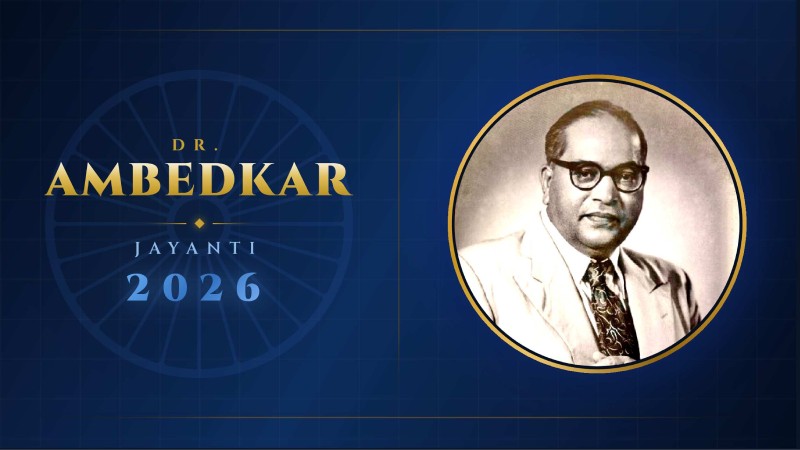
Dr. Ambedkar Jayanti is an annual event celebrated in India to mark the birth anniversary of Dr. Bhimrao Ramji Ambedkar. He was a political leader who played a pivotal role in drafting the Indian Constitution and served as the first Law Minister of independent India. He placed great importance on equality, justice, and human rights. This day is also celebrated as Bhimrao Jayanti or Equality Day. This day is celebrated as a tribute to his lifelong struggle for the poor and people of the backward caste.
This year, Dr. Ambedkar Jayanti will be celebrated on April 14, 2026. It is observed annually on April 14th. This event is held on the same date every year, without change, because of Dr. Ambedkar's actual date of birth. He was born on 14 April 1891 in Mhow, Madhya Pradesh. India is celebrating the 135th birth anniversary of Dr. Bhimrao Ambedkar in 2026. Ambedkar Jayanti 2026 is observed as a gazetted government holiday in many states of India. The first celebration of Babasaheb Ambedkar Jayanti began in 1928 in Pune, and since then, it has become an important celebration in India and internationally. Since 2015, Ambedkar Jayanti has been observed as a national holiday in 25 Indian states and union territories.
Who was Dr. Bhimrao Ramji Ambedkar?
He was an exceptionally intelligent and highly educated person. Dr. Ambedkar studied a lot, and his key academic degrees and achievements include Bachelor of Arts (BA), Master of Arts (MA), Doctor of Philosophy (PhD), Master of Science (MSc), Barrister-at-Law, Doctor of Science (DSc), and Honoris Causa Degrees. He was honored with the Bharat Ratna in 1990.
Bhimrao Ramji Ambedkar, also known as 'Babasaheb', was an Indian jurist, economist, social reformer, and politician. Dr. Bhimrao Ramji Ambedkar was the 14th and youngest child of Ramji Maloji Sakpal and Bhimabai Sakpal. He was born into a 'Mahar' (Dalit) family. Ambedkar went on to become an extraordinary scholar, an influential politician, and a visionary of the radical democracy of India.
Significance of Ambedkar Jayanti
Ambedkar Jayanti is more than just a public holiday. It is a global celebration of Equality Day. He has an important role in drafting India's supreme legal document. Ambedkar is popularly known as the "Father of the Indian Constitution." He was selected for the Constituent Assembly and appointed as the chair of this drafting committee. The Constitution drafted by him was enacted on January 26, 1950. This day is celebrated as Republic Day. He did not merely frame laws; he also ensured that the Constitution would serve as a robust shield for the vulnerable sections of society. He outlawed discrimination against the 'untouchables' and guaranteed fundamental rights to all citizens. Furthermore, he ensured the provision of reservations in education and government employment for the Scheduled Castes and the Scheduled Tribes. Bhimrao himself faced and experienced these challenges and closely observed society. That is why he recognized the need to include these provisions in the Constitution.
How is Dr. Ambedkar Jayanti Celebrated?
Dr. Ambedkar Jayanti is celebrated in many ways. On this day, floral tributes are offered to statues and portraits of Dr. Bhimrao Ramji Ambedkar. Cultural programs are held to commemorate his ideas and contributions. Political and social figures deliver speeches highlighting their lives and principles. Public events and rallies are organized across various locations, while schools and colleges educate students about his life and work. His thoughts and teachings are widely shared across social media platforms.
Ambedkar Jayanti is celebrated across the entire country in India's states and union territories. Dr. Ambedkar Jayanti has more importance in Maharashtra, Tamil Nadu, Uttar Pradesh, Bihar, Karnataka, Madhya Pradesh, and Delhi.
Dr. Ambedkar's Struggle Against Caste Discrimination
Dr. Ambedkar faced discrimination many times in childhood and school due to caste. He was denied drinking water from the clay pot. He was forced to sit in a separate area in the classroom in school on his own mat. Other upper-caste children did not play with him. Bhimrao Ramji Ambedkar felt 'untouchable' discrimination in his school, college, society, and even cities like Mumbai. He faced extreme difficulties finding housing and no entry for him in hotels. But still, an upper-caste teacher (Krishnaji Keshav Ambedkar) liked Ambedkar despite caste differences. He recognized his abilities and praised Ambedkar.
Lessons from Ambedkar Jayanti
Ambedkar Jayanti teaches us an important lesson that to educate yourself, organise your community, and fight for justice. Dr. Ambedkar dedicated his entire life to fighting for their right to education, access to water, entry into temples, and political representation. Dr. Bhimrao Ramji Ambedkar died in his sleep from chronic health issues on December 6, 1956, at his home in Delhi.