When is Bhai Dooj in 2026: Date and Time
In 2026, Bhai Dooj will be celebrated on Wednesday, 11 November. It marks the final and significant day of the Diwali festivities. It falls a few days after Diwali. Bhai Dooj is a festival celebrated on Dwitiya Tithi, the second lunar day of Shukla Paksha, in the Hindu month of Kartik.
Bhai Dooj 2026 at a Glance
| Detail | Information |
|---|---|
| Festival | Bhai Dooj / Bhaiya Dooj |
| Date | Wednesday, 11 November 2026 |
| Hindu month and tithi | Kartik Shukla Dwitiya |
| Tilak muhurat (Aparahna) | 1:10 PM–3:20 PM IST |
| Muhurat duration | 2 hours 10 minutes |
| Dwitiya Tithi begins | 10 November 2026 at 2:00 PM IST |
| Dwitiya Tithi ends | 11 November 2026 at 3:53 PM IST |
Bhai Dooj Tilak Muhurat Across Major Cities
All timings are in Indian Standard Time (IST).
| City | Tilak Muhurat |
|---|---|
| New Delhi | 1:10 PM–3:20 PM |
| Bengaluru | 1:13 PM–3:32 PM |
| Chennai | 1:02 PM–3:21 PM |
| Lucknow | 12:56 PM–3:07 PM |
| Nagpur | 1:05 PM–3:19 PM |
| Surat | 1:30 PM–3:44 PM |
In some traditions, Bhaiya Dooj is celebrated twice a year: once after Holi and once after Diwali. But mostly, people celebrate Bhaiya Dooj after Diwali.
About Bhai Dooj and its importance
Bhaiya Dooj is a holy festival that celebrates the eternal love and affection between brothers and sisters. On this occasion, sisters apply a ceremonial tilak to their brothers’ foreheads and pray for their long life, prosperity, and happiness. In return, brothers give their sisters gifts. Brothers also pledge to protect and support their sisters. The name “Bhai Dooj” is made up of two words: “Bhai,” meaning brother, and “Dooj,” meaning Dwitiya, the second lunar day of a fortnight. Bhai Dooj falls in the bright fortnight after Amavasya. The festival is also known as Bhaiya Dooj, Bhau Beej, Bhratri Dwitiya, and Bhaiya Dwitiya. Brothers visit their sisters’ homes to celebrate this occasion.
Sisters prepare a puja thali, offer them sweets, and apply a tilak to their foreheads. Bhai Dooj is also called Yama Dwitiya because, according to tradition, Yamraj visited his sister, Goddess Yamuna, on this day. Bathing in the Yamuna River on Bhai Dooj is considered especially sacred. It is believed that those who bathe in the river are cleansed of their sins and blessed with prosperity.
How to Celebrate Bhaiya Dooj
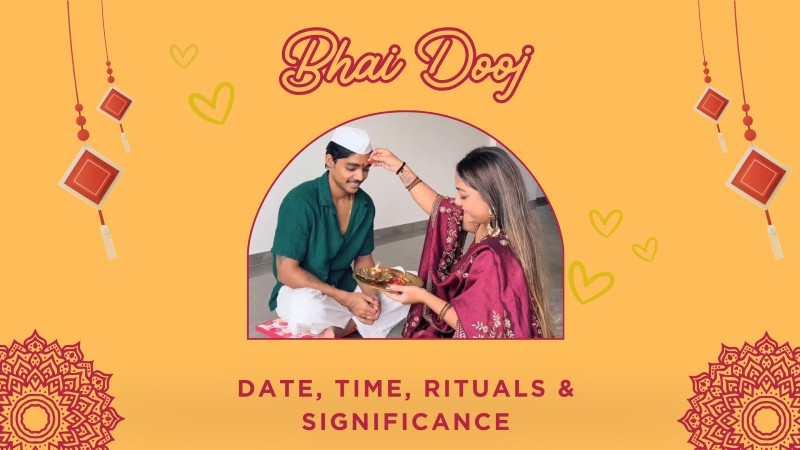
So let's learn how you can celebrate Bhaiya Dooj at home. On Bhaiya Dooj, both the brother and sister wake up early, take a bath, and prepare themselves for worship with a clean body and mind. The sister prepares a puja thali with roli (red ceremonial powder), akshat (unbroken rice grains), a coconut, sweets, a betel leaf, a dried coconut, and a lamp. When a brother visits his sister's home, or when you come to your brother's home, she asks him to sit on a chowki (a low wooden seat). The brother's face should also be in the East, North, or Northwest direction during the Bhai Dooj ceremony. The brother's face may also be in the East, North, or Northwest direction during the Bhai Dooj ceremony. But it is not a universal rule. Then sister applies a tilak of roli or kumkum, with akshat, to brother forehead, according to family custom. She then performs his aarti and offers him sweets. Brothers promise to protect their sisters, while sisters offer blessings and pray for their brothers’ long life and prosperity.
You should also need to know which finger should be used to apply the tilak. If the brother is older, a sister should apply a tilak on his forehead using the ring finger, or if he is younger, use the thumb.
Brothers give their sisters gifts such as clothes, money, and other presents. In many households, the story of Bhaiya Dooj is also recited or listened to on this day. Some families tie a sacred red and yellow thread (mauli) on the wrist during a prayer or puja performed on the day. But tying a thread is not a core part of traditional Bhai Dooj rituals.
If your brother or sister lives far away, you can also celebrate Bhai Dooj virtually. If you do not have a brother or sister, you can celebrate with cousins or others you consider siblings, or through spiritual worship and by expressing your feelings.
Bhai Dooj Fasting
Some sisters also observe a fast on Bhai Dooj in the morning, but it is not compulsory on Bhai Dooj. The Bhai Dooj fast is broken after the sister completes the tilak ceremony. She offers her brother sweets and other food, then breaks her fast by eating something herself.
What is the story of Yamraj and Yamuna behind Bhai Dooj?
Bhai Dooj, also called Yama Dwitiya, is celebrated to honor the loving bond between Yamraj and his sister Yamuna. Yamraj is known as the god of death, while Yamuna is the goddess of the Yamuna River.
The story behind Bhaiya Dooj is that Yamuna repeatedly invited her brother Yamraj to her home, but he was always busy with his duties in the afterlife. One day, on Kartik Shukla Dwitiya after Diwali, Yamraj visited Yamuna, giving her a pleasant surprise.
Delighted, Yamuna warmly welcomed her brother, prepared various dishes for him, performed his aarti, and prayed for his long life. She also applied a vermilion tilak to his forehead.
Pleased with Yamuna’s love and hospitality, Yamraj asked her to choose a boon. Yamuna asked that any brother who visited his sister’s home on this day and received a tilak should never fear death or misfortune.
Yamraj granted her wish and said that brothers and sisters who bathed in the Yamuna River on this day would be freed from their sins and receive blessings.
What is the difference between Bhai Dooj and Raksha Bandhan?
Some people think that the rituals of Bhai Dooj are similar to those of Raksha Bandhan. But there is a difference between the two. On Raksha Bandhan, sisters tie a rakhi on the wrists of their brothers, and on Bhai Dooj, sisters put a ceremonial tilak on the foreheads of their brothers and pray for their long life. Raksha Bandhan is usually observed in August, while Bhai Dooj is generally celebrated in October or November. Traditionally, on Raksha Bandhan, sisters visit their brothers’ homes to tie a rakhi, while on Bhai Dooj, brothers visit their sisters’ homes to receive a tilak.
Which prayer or mantra is recited during Bhai Dooj?
However, there are many mantras or bhajans to recite during Bhai Dooj, but the following are a few of them:
The Tilak Mantra: "यमद्वितीया तिलकं ददामि, आयुरारोग्यं विजयं देहि।" Meaning: This tilak on Yama Dwitiya: Give my brother a long life, Good health, and victory.
Chanting to Lord Yama: "ॐ यमाय नमः." Meaning: Salutations to Lord Yama, honoring the mythological origin of the festival.
Blessings for the Brother: "आयुष्मान् भव, सौम्यः भव." Meaning: May you live long and remain gentle.
What food and sweets are traditionally prepared on Bhai Dooj?
To celebrate their brothers’ visit, sisters usually prepare a variety of sweet and savory dishes. Kheer, phirni, and suji halwa are common dishes prepared at home.
Other home-made sweets are gulab jamun, rasgulla, motichoor laddoos, and kaju katli. Pinni and sohan halwa are loved in Punjabi homes.
In Bengal, brothers get to eat sandesh and rasgulla. In Maharashtra, basundi and puran poli; and in Gujarat, khandvi and ghari.
In many Uttar Pradesh homes, the festive meal often includes puri or bhature, potato curry, chole, paneer butter masala, and dal makhani.
In Bengal, the popular dishes are luchi, cholar dal, shukto, and fish. Food may be different in different parts of India, but this festival has a beautiful tradition of making special meals to celebrate the bond of brother and sister.
Bhai Dooj is a festival where sisters pray for their brothers’ long life, prosperity, and well-being. Brothers, in turn, promise to protect their sisters.