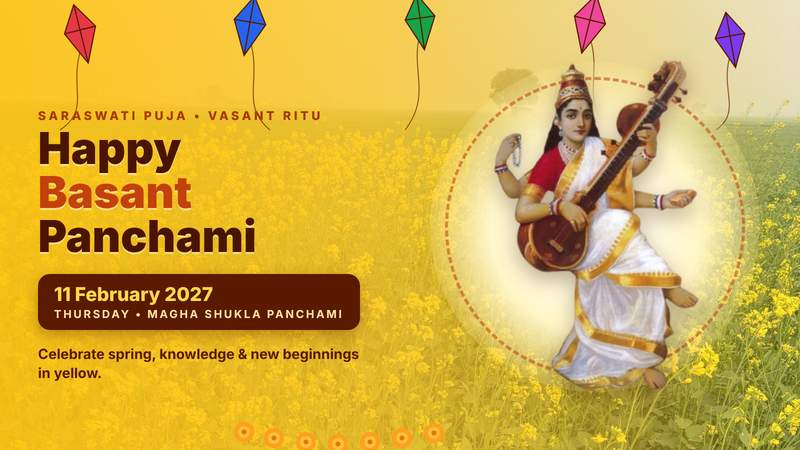
Basant Panchami is a festival celebrated in the month of Magh. It marks the arrival of the spring season. The festival is celebrated by Hindus and Sikhs in many parts of India. It falls on the fifth day of the Magh month, which usually comes in January or February. It falls on Magh Shukla Panchami, the fifth day of the bright fortnight. Basant Panchami is also known as Vasant Panchami or Saraswati Puja.
When is Basant Panchami in 2027?
| Event | Date |
|---|---|
| Basant Panchami 2027 | Thursday, February 11, 2027 |
Why is Basant Panchami celebrated?
There are seasonal and religious reasons to celebrate Basant Panchami. As winter ends and warmer days arrive, nature begins to bloom. Vasant Panchami is also celebrated as the Goddess Saraswati Jayanti. It is believed that on this day, Lord Brahma created sound and language through Goddess Saraswati. This is why the day is considered important for artists and musicians. In North India, this time of year also coincides with the blooming and ripening of the mustard crop in the fields.
In Hindu tradition, Basant Panchami is considered an auspicious day to begin learning. Many families perform Vidyarambh. It is a ceremony marking a child's introduction to education.
What is the difference between Basant Panchami and Vasant Panchami?
There is no difference between Basant Panchami and Vasant Panchami. They are two names for the same festival. Vasant is a Sanskrit word that means the spring season, while Panchami means the "fifth day." Many people know the festival by the name Vasant Panchami, while in North India, people who speak Punjabi, Hindi, and other regional languages often pronounce and write it as Basant Panchami. This is because the "V sound changes to a "B" sound.
Why is Goddess Saraswati worshipped on Basant Panchami?
Goddess Saraswati is worshipped by Hindus on Basant Panchami because the festival marks Saraswati Jayanti and the arrival of the spring season. Spring represents new beginnings and the growth of wisdom. Students also worship Goddess Saraswati for wisdom, knowledge, and success in their studies.
Why do people wear yellow on Basant Panchami?
People wear yellow clothes on Basant Panchami because, with the beginning of the new season, the sunlight becomes brighter and the countryside turns golden. The color yellow represents new energy and fresh beginnings. Mustard flowers and marigolds also bloom during this time. In this way, yellow becomes a natural reflection of the season. It is also believed that Goddess Saraswati likes the color yellow.
People also make yellow-colored foods such as Kesar Halwa, yellow rice, or Boondi Ladoo on Basant Panchami. So the yellow color symbolizes blooming mustard fields and prosperity, coloring clothes, flowers, and foods.
What is the significance of kite flying on Basant Panchami?
Kite flying is also a part of Basant Panchami celebrations. Children and adults fly kites from the rooftops of their homes or in open fields. Kite flying is also considered a symbol of joy, freedom, and high hopes. It is said that Maharaja Ranjit Singh helped popularize kite flying during Basant celebrations in 19th-century Punjab. He made this tradition popular as a cultural and social celebration.
What is the significance of Raag Basant in Sikh tradition?
In Sikh tradition, Raag Basant is related to spiritual renewal, inner joy, and the blossoming of the soul through Naam (Divine Name). Hymns in Raag Basant appear on Angs 1168-1196 of Sri Guru Granth Sahib Ji, composed by Sikh Gurus and Bhagats. At Sri Harmandir Sahib, Amritsar, Basant Kirtan follows a seasonal tradition from Maghi di Sangrand to Hola Mohalla.
How is Basant Panchami celebrated in Sikh tradition?
Basant Panchami has cultural and historical significance in Sikh tradition. Sikhs remember important historical events associated with the day, including the marriage of Sri Guru Gobind Singh Ji and Mata Jito Ji at Guru Ka Lahore. Special gatherings and fairs are also held at certain gurdwaras.
Basant Panchami is a seasonal cultural and seasonal festival. The way this festival is celebrated varies across regions, as it is also observed in Bihar, Maharashtra, West Bengal, Odisha, and Assam.