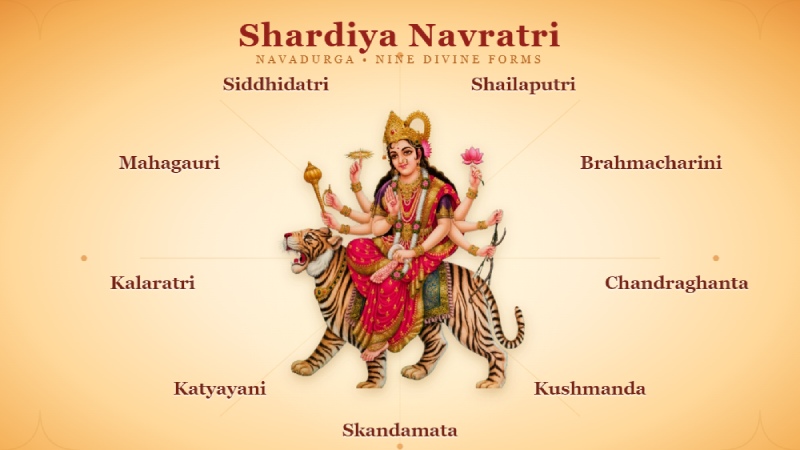
Shardiya Navratri is also known as Maha Navratri. It is the most popular and important Navratri of all Navratris. The name Shardiya Navratri is taken from Sharad Ritu. Shardiya Navratri is a nine-day festival. It is dedicated to nine forms of Goddess Durga Shakti.
When does Shardiya Navratri start and end in 2026?
What is the Ghatasthapana time, and how is it performed?
Ghatasthapana marks the beginning of Navratri. It should be performed during an auspicious Muhurta. The auspicious timing for Kalash Sthapana (Ghatasthapana) during Shardiya Navratri 2026 is from 6:19 AM to 10:12 AM. Its timing may vary according to your location. You should avoid Kalash Sthapana at night and during Amavasya.
Here is the traditional way to perform Ghatasthapana at home. You need a pot, fertile soil (best if you can bring it from a field), and barley seeds (known as Jau). First, clean your pooja area, fill 5 or 7 pots with soil, and sow barley seeds in these earthen pots. After this, sprinkle a small amount of water over them and cover all the pots with mango or Aak leaves. Keep the soil moist until the barley sprouts emerge from the seeds. Also, keep all the pots where they receive morning sunlight in your home.
Ghatasthapana, or Kalash Sthapana, must be performed during the first third of the day while Pratipada Tithi prevails. If you miss the Ghatasthapana Muhurat, you can perform this ritual during the Abhijit Muhurat around midday.
How to do Kalash Sthapana during Shardiya Navratri?
Kalash Sthapana is performed on the same day. Its timing and ritual are almost the same. But you need to place it on a wooden chowki facing east or north. Sow barley seeds in a shallow clay pot filled with soil. Place the Kalash over or beside the barley pot as part of the Ghatasthapana arrangement. After that, tie a sacred mauli thread around a copper or earthen kalash. You need to fill the pot with holy Ganga water, coins, betel nuts, and a pinch of turmeric. You can arrange five mango leaves around the rim. You should place a red-cloth-wrapped coconut on top. Keep the kalash centrally over the barley pot to invoke Goddess Durga.
What are the nine forms of Durga, and which goddess is worshipped on each day of Shardiya Navratri?
There are nine forms of Goddess Durga, which are also known as the Navadurga. People worship one form on each of the nine days of the festival of Shardiya Navratri. The following are the goddesses worshipped on each day of Shardiya Navratri 2026.
| Day No. | Durga Maa name | Date |
|---|---|---|
| 1st day | Maa Shailputri | October 11, 2026 |
| 2nd day | Maa Brahmacharini | October 12, 2026 |
| 3rd day | Maa Chandraghanta | October 13, 2026 |
| 4th day | Maa Kushmanda | October 14, 2026 |
| 5th day | Maa Skandamata | October 15, 2026 |
| 6th day | Maa Katyayani | October 16, 2026 |
| 7th day | Maa Kalaratri | October 17, 2026 |
| 8th day | Maa Mahagauri | October 19, 2026 |
| 9th day | Maa Siddhidatri | October 20, 2026 |
What are the 9 colors of Shardiya Navratri 2026?
On each day of Navratri, there is a specific auspicious color. The nine auspicious colors of Shardiya Navratri 2026 are orange, white, red, royal blue, yellow, green, grey, purple, and peacock green.
How to do Shardiya Navratri Puja at home?
You can perform Navratri puja at home without a priest. First, clean your prayer area and put an idol or picture of Goddess Durga Mata ji on a wooden stool covered with a red cloth. You can also keep a Kalash that you prepared with the above procedure. You should light a ghee diya daily and offer fresh flowers and daily prayers. The devotees offer prasad in the form of red hibiscus flowers; fresh fruits; and food such as kheer or halwa, poori, and black chana. During Navratri, recite the Durga mantra, Durga chalisa, and Durga saptashati.
What foods are allowed and avoided during Navratri vrat?
Many devotees keep fast during all nine days of Navratri. They only eat flours like buckwheat (kuttu), water chestnut (singhara), and amaranth (rajgira) during a Navratri fast. They can also eat makhana, tapioca pearls (sabudana), and barnyard millet (samak rice). You may also consume potatoes, dairy products, fresh fruits, and rock salt (sendha namak). The food that should be avoided during Navratri includes onion and garlic, regular grains, legumes and lentils, non-vegetarian foods, eggs, alcohol, and table salt.
Why is Shardiya Navratri celebrated every year?
Shardiya Navratri holds a special place among the Hindus in India. It is the celebration of nine forms of Durga Mata, who is worshiped for divine feminine energy. However, there are four seasonal Navratris celebrated in a year, like Chaitra Navratri (spring), Ashadha Gupt Navratri (monsoon), Shardiya Navratri (autumn), and Magha Gupt Navratri (winter). The Shardiya Navratri is of utmost importance for Hindus as it represents the victory of good over evil. According to Hindu mythology, Maa Durga killed the demon Mahishasura after fighting with him. This is the victory of dharma over adharma.
The Navratri nights are also celebrated by people through Garba and Dandiya dances to honor the goddess. People visit Maa Durga temples and pandals. Shardiya Navratri is not just a festival. It is a spiritual journey of faith, power, and prosperity.