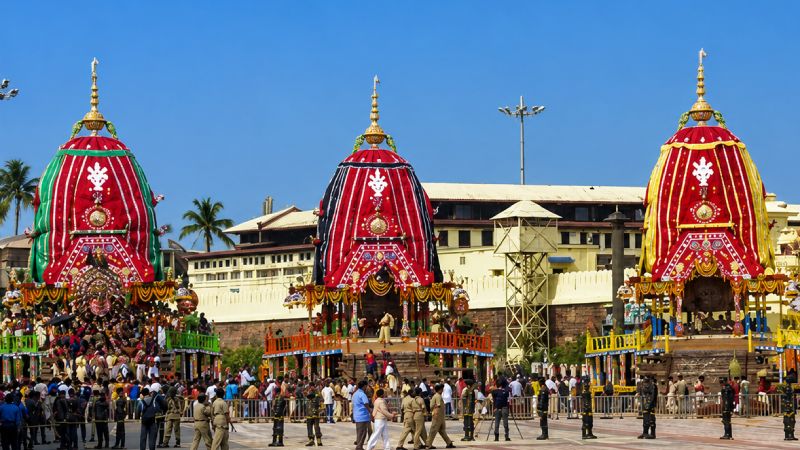
The Jagannath Puri Rath Yatra is also called the Chariot Festival. Jagannath Puri Ratha Yatra is a major Hindu festival. It is one of the oldest and largest annual religious processions in the world. It is organized every year at the most famous Jagannath temple in the holy city of Puri, Odisha, India.
When is Jagannath Puri Rath Yatra Date in 2026?
There are also some more events associated with this festival:
Bahuda Yatra is the return journey of Lord Jagannath, Balabhadra, and Subhadra to the Jagannath Temple. They come back after staying at the Gundicha Temple for a week.
Suna Besha takes place the day after Bahuda Yatra. The deities are decorated with beautiful gold ornaments while seated on their chariots.
Niladri Bije is the final ritual of the festival. The deities return to the Jagannath Temple, and Goddess Lakshmi welcomes Lord Jagannath by offering him Rasagola.
During Hera Panchami, Goddess Lakshmi visits the Gundicha Temple and playfully asks Lord Jagannath to return home.
Main events during this yatra:
Rath Yatra: July 16
Hera Panchami: July 20
Bahuda Yatra: July 24
Suna Besha: July 25
Niladri Bije: July 27
Why is Jagannath Rath Yatra celebrated?
Lord Jagannath is considered a form of Lord Vishnu. This festival is celebrated as the yearly journey of Lord Jagannath, along with his brother Balabhadra and sister Subhadra. The Jagannath Yatra starts at the Jagannath Temple in three magnificent chariots and goes to the Gundicha Temple in Puri. The nine-day festival marks their visit to their aunt's home and symbolizes the soul's journey toward God. According to Hindu sources, Goddess Subhadra expressed a desire to visit her aunt's home. Lord Jagannath and his brother Balabhadra accompanied her on a grand chariot ride to fulfill her wish. This Rath Yatra has great significance for Hindus because it symbolizes the soul's journey to salvation and shows that God's blessings are for everyone.
What are the names of the three chariots?
Puri begins to prepare for the Chariot Ride more than two months before the event. The deities ride on large, beautifully decorated wooden chariots that are pulled through the streets by thousands of devotees. Nandighosha is the chariot of Lord Jagannath. It is the largest chariot, with 16 wheels, a height of 45 feet, and a red and yellow canopy. Taladhwaja is the chariot of Lord Balabhadra. It has 14 wheels, a height of 44 feet, and a red and blue-green canopy. Darpadalana is the chariot of Goddess Subhadra. It has 12 wheels, a height of 43 feet, and a red and black canopy. The chariots are built every year without nails or modern techniques. Thousands of devotees pull the massive chariots using thick, sacred ropes.
Who and how can attend the Jagannath Rath Yatra?
However, Non-Hindus cannot enter the Jagannath Temple. But others can attend the Rath Yatra from outside. People of all religions and countries can watch the Rath Yatra. Watching the procession from the Grand Road is free. Anyone can help pull the chariots during the festival. VIP viewing and reserved seating are available through authorized tour operators. The Jagannath Temple remains open, but regular darshan is limited during the festival and special rituals.
Facts about Jagannath Puri Rath Yatra
The Jagannath Rath Yatra is over 1,000 years old. It has been recorded in Hindu scriptures for centuries. An estimated over 3 million devotees attend the annual Rath Yatra. Children, young people, and senior people of all age groups join the Jagannath Puri Rath Yatra. The chariots travel about 3 km from the Jagannath Temple to the Gundicha Temple.
How Is Jagannath Puri Rath Yatra Celebrated?
The Gundicha Temple is cleaned one day before devotees of the Jagannath Puri Rath Yatra. The festival begins with special prayers at the Jagannath Temple. Lord Jagannath, Balabhadra, and Subhadra's idols are placed on three large wooden chariots. The Gajapati King of Puri performs the Chhera Pahanra ritual by sweeping the chariots with a golden broom. Thousands of devotees then pull the chariots to the Gundicha Temple. The deities stay there for seven days. They return to the Jagannath Temple during the Bahuda Yatra. The festival ends with Suna Besha and Niladri Bije. Devotees offer prayers, sing devotional songs, and receive Mahaprasad.
So the Jagannath Puri Rath Yatra promotes equality. People from all backgrounds can have the darshan of Lord Jagannath outside the temple.